Libidinal infrastructures for a world in crisis
What makes a certain future desirable? In this essay we dive into the workings and politics of desire as it relates to technology.


This essay is a written-format-adaptation 0f a talk I gave at 'Tipping Point 2026: A day of critical sustainabilities', which brought together questions of community, collective agency, and life beyond the imperative of endless growth. It takes those questions as a starting point to ask how technology shapes our desires, and what might make a post-growth future desirable.
Imagine that the technological transition succeeds. Transport is electrified, cleaner energy powers our homes, buildings become more efficient, and digital systems coordinate resources with a precision that would once have seemed an extraordinary logistical feat. These would be remarkable achievements that would prevent perhaps some level of suffering and make specific forms of collective being a bit more possible.
Now imagine that almost everything else remains familiar. Work continues to accelerate, economic security depends on endless growth, convenience means paying someone else to absorb the inconveniences of daily life, our attention remains a resource to be captured, and a better life remains, above all, a life with more things (or subscriptions). What would have realistically changed?
Every transition carries an image of the good life.
We would have transformed processes of society while preserving much of its purpose intact. This thought experiment immediately raises a problem that technical accounts of sustainability often leave unresolved. The problem is that every transition carries an image of the good life. Before we decide what to electrify, automate, optimize, or replace, we have already made assumptions about which activities matter, which needs deserve investment, and what prosperity should feel like for everyone. Those assumptions are active guidelines of the transition, even when we do not intend them to be. Even when they remain hidden from sight.
An ecological transition, framed only as sacrifice, leaves the prevailing image of prosperity intact: consumption remains the good life, and sustainability becomes the unfortunate obligation that we have to bear. Our own sacrifice, in order to do our part to save the world we love. But it is my belief that a post-growth future needs a richer account of desire. What becomes desirable when prosperity means meaningful time, collective care, deeper relationships, ecological continuity, and active participation? What technologies emerge when the aim is collective capacity? What kind of work becomes possible when productivity no longer measures human worth?
These questions concern the organization of everyday life, but they also concern the institutions and infrastructures through which certain desires become practical, familiar, and natural. Our technologies help shape what we learn to want. An emancipatory ecological transition must therefore involve a transformation of the conditions under which desire develops.
The current ecological crisis cannot be reduced to a psychological failure, because it is a crisis of extraction, ownership, political power, and a profoundly unequal exposure to harm. A person struggling to heat their home or feed their family occupies a different position from someone deciding which of several homes to fly to and what food to order. Any account of desire that flattens those differences becomes another way of asking people with the least power to assume responsibility for arrangements they didn't choose to create.
Yet desire is part of how those arrangements reproduce themselves. Across much of industrial modernity, freedom became associated with unlimited mobility, security with private ownership, and prosperity with rising consumption. These associations acquired a material form in roads, housing, labor markets, advertising, businesses, and the distribution of public investment. Eventually, they became what most of us know as common sense.
A city that is organized around cars makes car ownership feel like a prerequisite for living in it. Jobs, schools, shops, and care become difficult to reach without a car, because life outside of home is only accessible with a car. The resulting desire for a car contains aspiration, but most importantly, it becomes a rational response to enforced dependence. Asking residents to make different choices that would not require a car while leaving those conditions intact mistakes a systemic constraint for a personal preference.
Electrifying the car, then, in response, changes an important part of this arrangement. A broader transformation, however, would also make proximity, accessible public transport, and usable public space into sources of freedom. People might discover that being able to move through a city without the expense and responsibility of owning a car is itself desirable. That possibility, however, requires a different organization of mobility, supported by investment and institutions capable of making the alternatives appealing and reliable.
The same reasoning applies to work, because when progress means producing more in less time, automation becomes an instrument for increasing expectations. Time saved reappears as additional capacity to be filled with more work. Under different arrangements, some of that time could become a shorter working day, an afternoon with a child, a hobby with colleagues or friends, or the opportunity to participate in the commons of the local community.
This is partly why the language of sustainability can feel exhausted. It promises transformation while repeatedly reassuring us that the familiar world will continue. We will preserve competition and consumer aspiration by making their technical foundations cleaner and greener. The future arrives as an improved version of the present, carrying many of the same obligations as before and, most importantly, no disruptions.
There are understandable reasons for wanting continuity. People hate change. They need security, and the ecological crisis already threatens livelihoods and places they love. But continuity becomes a trap when it protects institutions that produce insecurity while treating any alternative as an intolerable disruption. Sustainability, in that case, becomes the management of the contradiction of acknowledging the need for profound change while narrowing the range of changes we are permitted to desire.
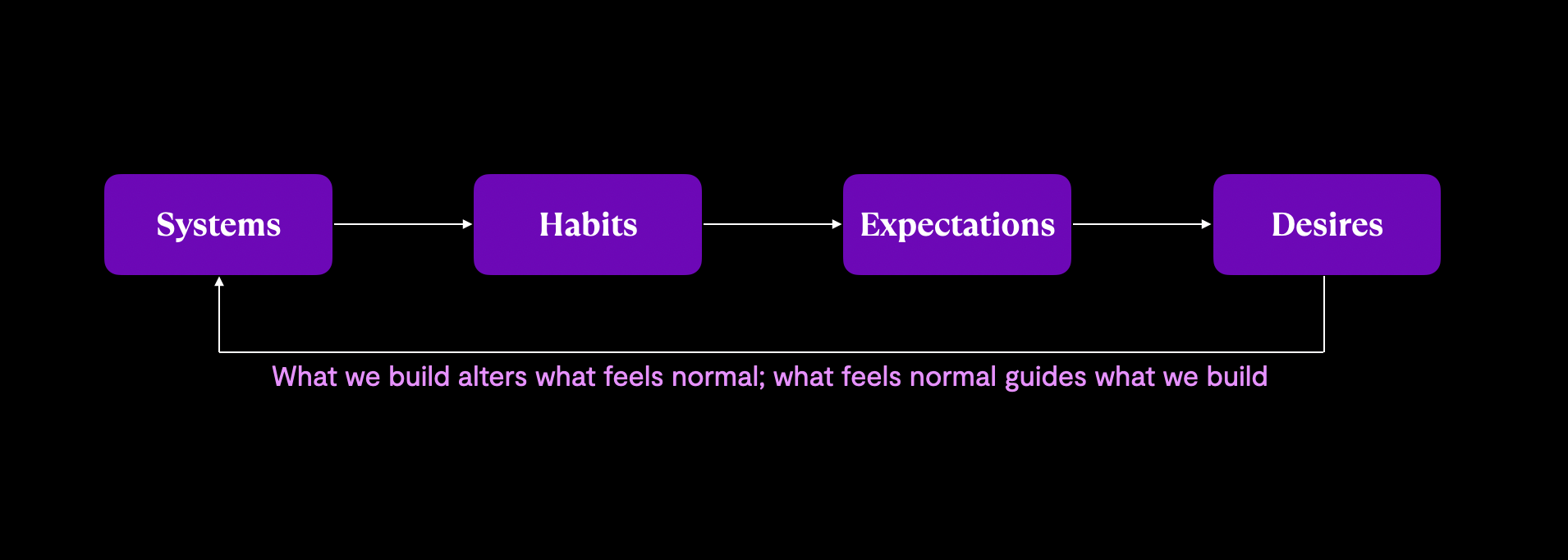
The older promises of technological progress retain their force because they responded to real needs. Freedom from exhausting labor, protection from hunger, warmth, mobility, and access to knowledge are all actual desires worth pursuing, and they all remain worthwhile ambitions. How might we recover those ambitions while questioning the material and institutional forms through which we have been taught to pursue them? Security doesn't have to require endless private accumulation. Pleasure doesn't have to depend on a permanent succession of purchases. A life can become richer through relationships and capacities that the cold reach of market logic may struggle to recognize.
Thinking about desire helps explain how such possibilities might emerge, because desire is often understood through absence: we lack something; therefore, we seek to acquire it. In Anti-Oedipus, Deleuze and Guattari instead describe desire as productive, involved in making connections and producing social reality. Their argument challenges the assumption that desire begins with a missing object or a condition that we need to feel complete.
For emancipatory politics, we can take this challenge seriously while recognizing the experience of deprivation being present too. The absence of time, care, safety, or community can become a valid starting point for collective invention. People who may recognize that absence may organize a shared space, establish a care network, or reclaim time from work. Through doing so, they may encounter relationships and possibilities they could scarcely have specified beforehand. An initial need extends onto an activity that changes their sense of what is worth wanting.
This is a practical interpretation rather than an attempt to reconcile entire philosophical traditions. Its significance is that political imagination can develop through participation. People can discover desires through making arrangements together. A different life becomes conceivable because part of it has become available to experience. And then that desire grows.
I use the term libidinal infrastructures (heavily influenced by Jean-François Lyotard and his book on Libidinal Economy) for the technical, spatial, and institutional arrangements through which desire is organized and reproduced. Systemic infrastructures make certain actions easier, reward particular habits, and establish expectations about how life should be organized around them. Those expectations can, in turn, generate demands for more of the same infrastructure.
A digital service organized around continuous engagement invites us to experience availability as a social obligation. A workplace system that renders every task measurable encourages a view of time as accountable output. On the other hand, a public library offers another relationship with access to shared resources, room to linger, time spent doing something unproductive, and participation that doesn't begin with a purchase.
These arrangements influence people. Users improvise, refuse, and repurpose. Desires remain contradictory, messy, and contested. Nevertheless, the conditions through which we encounter the world affect what appears possible within it. Infrastructure can make dependence seem inevitable, but it can also give people the practical means to develop greater autonomy together.
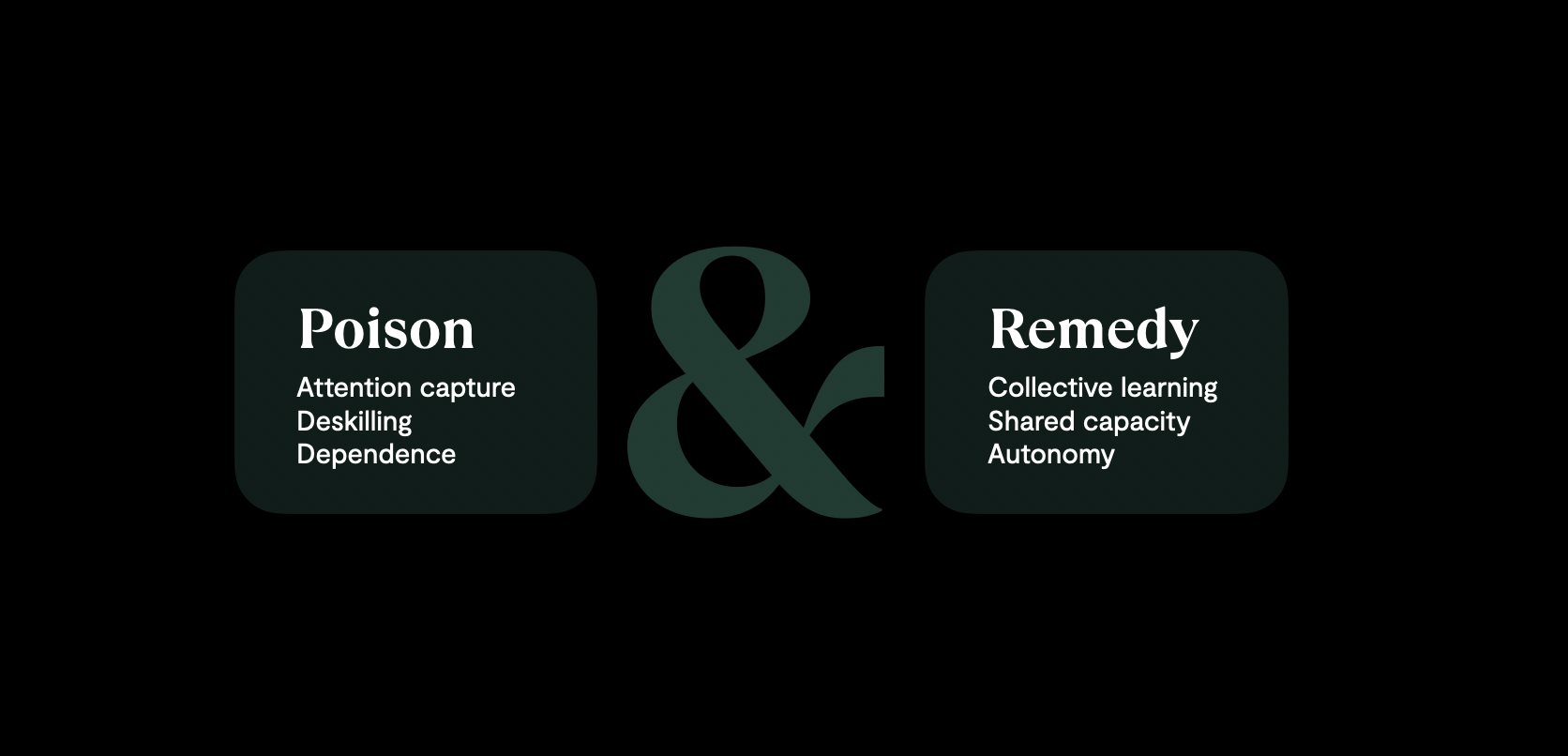
Bernard Stiegler's account of technics as pharmacological is useful here. The pharmakon carries the possibility of both poison and remedy. Technology is a pharmakon in the sense that it participates in the formation of human capacities, and the organization of technology can also undermine those same capacities. A medium through which knowledge is transmitted can become an apparatus for capturing attention, and produce analysis paralysis. A system intended to assist you with writing can be arranged so that people lose opportunities to practice, understand, or exercise judgment.
An emancipatory evaluation of technology must therefore examine its effects on the people and relationships that sustain it, alongside its material demands. Does it help people learn? Can they question its operations? Does it support deliberation and shared competences? What happens when it fails, or when its owner changes the terms of access? Can they change the system's conditions themselves?
There is, of course, an underlying danger in this argument. If technologies help shape desire, someone will inevitably propose using them to manufacture the "correct" ecological citizen. Surveillance, behavioral scoring, or carefully calibrated incentives could be justified as instruments for teaching people to want less. Existing hierarchies would acquire a greener vocabulary but stay largely the same.
An emancipatory transition requires people to have a meaningful part in determining the conditions of their own lives. That includes the ability to question an objective, challenge an institution, refuse a system completely, and propose another arrangement. Participation needs material support with time, accessible information, public resources, and protection from the consequences of dissent. A consultation process means little if every consequential decision has already been made by experts.
Ecological limits are real, and democratic disagreement cannot abolish them. But the distribution of resources, obligations, decisions and opportunities within those limits remains political. Different communities will pursue different forms of collective life. A credible transition must make room for plurality, while at the same time confronting inequalities in power and consumption.
How can people desire arrangements they have never experienced? Often, by encountering an incomplete version of them. A repair collective can make competence and mutual assistance pleasurable. A community kitchen can turn eating into an occasion for shared provision. An energy cooperative can give residents a practical relationship to decisions that otherwise arrive as bills and distant announcements.
Such experiences are sometimes described as prefigurative: people attempt to enact aspects of the relationships they want to extend. Their importance lies partly in the outcomes that that participation reveals. Someone arrives at a repair collective because an appliance is broken and discovers the satisfaction of learning how to fix it alongside others. Someone joins a local initiative for a practical reason and develops an appetite for having a say. Experience gives our imagination something to work with.
David Graeber's distinction between poetic and bureaucratic technologies offers a related provocation. The Apollo program turned the dream of walking on the moon into an engineering project. Medieval cathedrals used geometry, craftsmanship, and generations of collective labor to give physical form to visions of what people imagined as divine. Transcontinental railways made the once extraordinary ambition of crossing an entire continent by machine a possibility.
David used poetic technologies to describe technical and organizational means directed toward realizing seemingly impossible visions. He also recognized their capacity for domination and ecological destruction. An ecological version of that ambition might begin with ordinary freedoms: secure shelter, time beyond employment, dependable care, access to knowledge, and the ability to participate in shaping a place. Making these widely available would require substantial institutional invention. Their familiarity should not obscure the scale of change involved in guaranteeing them.
Local experiments cannot carry that transformation alone. A prototype without realization becomes an art installation. A cooperative without resources can rely on unpaid labor until its members burn out. A celebrated community initiative can provide political cover for withdrawing public services. Calling an arrangement collective tells us little about whose time it consumes or who can afford to participate.
Durability requires attention to ownership, funding, labor, and authority. Who maintains the infrastructure? Under what conditions? Can members alter the rules? How does an initiative connect to public institutions, labor organizations, and other communities? What protects it from enclosure once it demonstrates value? These questions determine whether an experiment expands people's agency or simply recruits their goodwill.
We need people to make these relationships legible, workable, and open to revision. That involves understanding how a service interface connects to an institution, how convenience redistributes labor, and how a service changes the capacities of those who depend on it. It also requires people to participate in arguments about what deserves to be built and whose judgment counts. An efficient experience can still serve an impoverished account of life.
Perhaps what has become exhausted is the promise that sustainability will preserve the present indefinitely. Sustaining care, ecological relationships, and collective well-being remains an unfinished political project. It requires technologies that people can understand and govern, institutions capable of supporting shared life, and opportunities to experience prosperity beyond accumulation.
That future will involve relinquishing things, particularly forms of consumption and power whose costs are imposed on others. Its desirability cannot rest on pretending otherwise. But neither can its appeal depend entirely on the moral dignity of sacrifice. People need the means to encounter what they might gain: time that belongs to them, dependable relationships, meaningful participation, and a world whose continuity they can help secure.
We have spent decades asking how to sustain the world we know. We also need opportunities to discover what kind of world we would want to sustain.
Selected references
- Deleuze, Gilles, and Félix Guattari. Anti-Oedipus: Capitalism and Schizophrenia (1972).
- Lyotard, Jean-François. Libidinal Economy (1974).
- Stiegler, Bernard. Taking Care of Youth and the Generations (2010).
- Stiegler, Bernard. What Makes Life Worth Living: On Pharmacology (2013).
- Graeber, David. “Of Flying Cars and the Declining Rate of Profit” (2012).
- Fisher, Mark. Postcapitalist Desire: The Final Lectures. Edited by Matt Colquhoun (2021).
- Jackson, Tim. Prosperity without Growth: Foundations for the Economy of Tomorrow. Second edition (2017).
- Illich, Ivan. Tools for Conviviality (1973).
- Weeks, Kathi. The Problem with Work: Feminism, Marxism, Antiwork Politics, and Postwork Imaginaries (2011).
- Ostrom, Elinor. Governing the Commons: The Evolution of Institutions for Collective Action (1990).