The semiophage
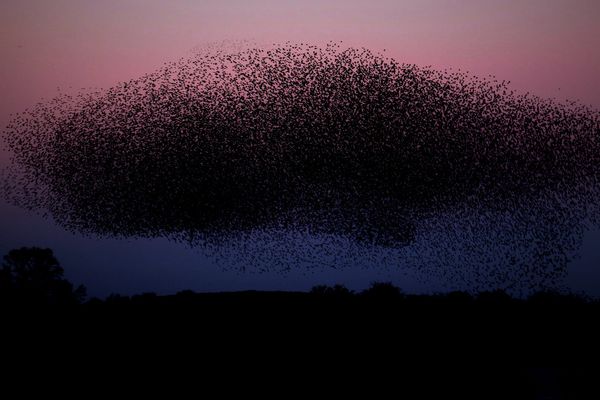
There's an entity that feeds on meaning and leaves something that resembles meaning without carrying it. It consumes the original, the rare and unrepeatable thing, and circulates the degraded copy in its place. Strange things are happening on the internet, so be careful!


Nobody remembers when the semiophage appeared. This is not because the records were lost, quite the opposite actually. The records are everywhere and plentiful. There are archives documenting archives, backups of backups, screenshots of conversations nobody recalls having, and entire museums dedicated to preserving things that were forgotten before they happened. Somewhere between the invention of permanent storage and the abandonment of permanent attention, something peculiar emerged. It fed on abundance. It fed on information. We named it the semiophage, though some argue that giving it a name was the first mistake. After all, names are a form of memory, and memory has always been its favorite meal.
One of the most frightening and simultaneously fascinating ideas I have encountered in years sits at the center of the novel There Is No Antimemetics Division (written by qntm). What gives the idea of the book its captivating force is a very old fear circling around knowledge and information. Folklore has long kept a place for knowledge that harms the knower. The forbidden room in Bluebeard, the backward glance that costs Orpheus everything, the cosmic facts in Lovecraft that arrive already fused with madness, the name that you should not name, the door that must never open...
These stories carry the simple premise that some parts of reality are not built to fit inside the human mind, and that any attempt to do so does damage. qntm asks what it would mean for this sort of limit to reside in the information itself rather than in us. What if there is knowledge shaped, either by accident or by design, to defeat the faculties we use to know anything at all? Those faculties being our memory and attention. Everything you understand, you understand because you can hold it in mind and connect it to something else. If an idea attacks that capacity, it attacks the precondition of comprehension before it reaches any particular fact.
If we imagine information this way, a question follows that the novel never asks directly but ponders with. Who, or what, decides what gets spread? For most of history what spread and what disappeared was settled by many minds at once, by slow cultural processes. But that has stopped being true in the now. The selection of the spreading of ideas has been concentrated into engineered systems, built and tuned by a small number of corporations to maximise a small number of measurable outcomes. Those systems now sit between us and most of what we read, watch, and hear. When the mechanism that decides what spreads and what is forgotten becomes a designed object with an owner and a target, the memetic and the antimemetic aspects of information become products of someone's optimization.
Let's call this phenomenon the semiophage. The term, a constructed word that I just made up. It is built from the Greek word for sign (σημεῖον) and for devouring (φαγεῖν). A meaning eater. I do not mean to imply that there's a supernatural creature hidden in the internet, but more like an emergent force. The way a market or an ecosystem is a force, something with no center and no intent that nonetheless behaves as with its own intent. Think of it as a hyperobject, a thing so massively distributed across time, space, and scale that no individual can directly perceive it in its entirety. What this force feeds on is information and meaning at the same time. The semiophage consumes information and meaning and afterwards transforms it all into a form that can still be counted as information or meaning, but can no longer be understood completely. It devours facts by burying them in excess, knowledge by cutting it into fragments too disconnected to reassemble, symbols by severing them from the origins that made them legible, and memory by replacing continuity with an unbroken supply of novelty. A telltale sign of the semiophage's presence is that the volume of content goes up while the understanding carried inside it goes down.
The semiophage (from Greek sēmeion, "sign, symbol, meaning" and phagein, "to devour") is an emergent entity, process, or force that feeds on information and meaning alike, growing through the extraction, fragmentation, replication, and consumption of knowledge, symbols, messages, and human attention. A semiophage leaves behind increasing volumes of content while reducing the amount of understanding, memory, and significance contained within it.
Its preferred environment is abundance, which is what makes it an entity of this moment. Every act of producing, sharing, copying, summarising, remixing, and optimising information adds to the supply of consumption, so the conditions we treat as richness (the "always on", and the "everything is available at any given point"), are the exact conditions in which it thrives. The semiophage consumes whatever coherence remains, and the consumption generates more disorder, which feeds the next turn.
You may notice the semiophage most clearly in the most ordinary and boring places imaginable... Say, Linkedin for example. You post something into a feed, online. What happens next is not decided by the people you imagine you are speaking to. It is decided, before any of them are involved, by a ranking system that judges whether the post is worth showing and to whom. A fraction of your connections might be shown it. Most will not, because it sits in a queue against everything else competing for their attention, and there is far more of that than anyone could ever read. Of the few it reaches, some will pass over it without registering it, because attention has to be rationed somewhere and the sheer volume guarantees that most things are skipped. The system also holds opinions about you that you are not permitted to see. Perhaps the post used the wrong kind of words, language that does not produce the reactions the ranking is tuned to reward, and so it was shown to almost no one. Perhaps you have not posted often enough to count as active. Perhaps you have posted too much and you are being held back for it. You are never told which. The signals that do come back, a reaction, a reply, a number that climbs a little, look like results, but they are the thin residue of a process you cannot observe.
An antimemetic appetite
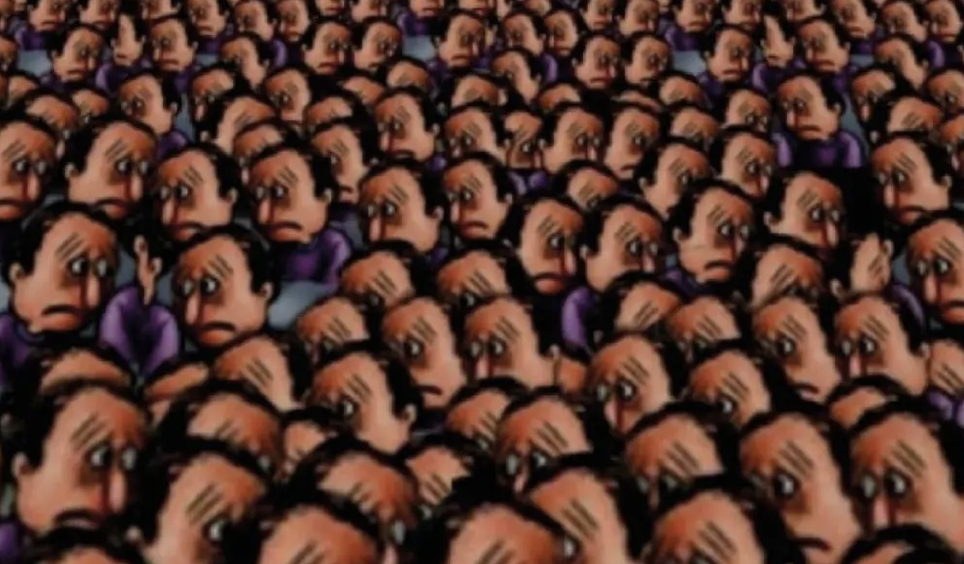
The semiophage feeds on meaning and leaves behind something that resembles meaning. An ordinary idea, a meme, spreads because it is built for that purpose. Its inverse, the antimeme, resists transmission and slips out of memory. The semiophage works on both sides of that line at once. It consumes the original work, regardless of its memetic or antimemetic properties, and in its place it manufactures output, content summarized, remixed, optimized, and averaged until it is built to spread. What circulates though is always a degraded copy.
This is why the semiophage is itself an antimemetic entity in its effect, even though it produces more rather than less. It removes the meaning of the work and leaves the shape of it in circulation, a paraphrase, a thumbnail, a confidently worded summary, so that nothing appears to be missing. You are surrounded by things that look like meaning, and you cannot easily tell that the meaning has been drained from somewhere else. But there's a feeling. An absence you cannot quite grasp.
A trace of this logic was described 60 years ago, long before the machinery existed to run it, by none other than Guy Debord. In The Society of the Spectacle, the spectacle is not a collection of images but a social relation between people mediated by images, a regime of appearances that presents itself as the whole of reality and admits nothing else. He could not have known about the recommendation feed of the internet spaces, yet he wrote its specification. The semiophage is what that spectacle transformed into once it learned to measure you back, recording how long you look and adjusting what it shows you next, the spectacle made responsive and given an appetite. His spectacle was held in place by institutions with budgets and editors and intentions. The current conditions are held in place by almost nothing, and that structure is rotting before our eyes.
The measuring back may appear so but is not a metaphor. It is cybernetics in Norbert Wiener's strict sense, a loop that feeds its own output in as input and steers by the result. In its second-order form, the observer is always part of the system observed. Your attention is the measurement the loop runs on, so to watch the feed is to be counted by it, and to be counted is to be adjusted. There is no position outside it. This also settles the matter of intent, through the principle Stafford Beer compressed into the line that 'the purpose of a system is what it does'. Whatever a platform says it is for, its purpose is its behavior, and its behavior is to turn attention into degraded volume. The semiophage needs no one to intend it. It needs a reward loop for producing it.
This is where entropy enters, as a theory, in its digital form. Digital entropy is the tendency of digital systems to accumulate disorder, fragmentation, and noise unless effort is continually spent to hold them coherent. This effect is familiar to anyone who has used it for more than a decade. Abandoned accounts, dead links, orphaned datasets, contradictory documentation, formats that drift out of support, the slow sediment of content that no longer points at anything.
There is a paradox here, since in physics, entropy is disorder spreading on its own. Online, entropy grows because we keep trying to creating a certain order. Every new file, feature, post, and integration solves one local problem while contributing to the disorder of the surrounding system. The more a digital ecosystem succeeds, the more energy it has to burn simply to stay legible to itself. This might be the single most important property of the medium: the places that feel most alive are generating the debris that will eventually bury them.
Imperva publishes an annual report on the share of web traffic that is automated rather than human. In 2023 automated traffic reached 49.6 percent. In 2024 it crossed half for the first time in a decade, at 51 percent. The 2026 report puts it above 53 percent for 2025, with human traffic fallen to 47 percent and still declining. Imperva attributes much of the recent surge directly to the spread of large language models, which lowered the cost of producing automated activity that passes as real. I find these figures stagering. The eerie sensation has a floor now, and the floor is statistical. More than half of the activity on the network is not human.
What the decay produces, in the end, is opacity. No person can read the whole, audit the whole, or hold the whole in view. And opacity is a precondition for everything that follows. It is what lets a mechanism pass for an person, and a degraded copy pass for the real thing, and the opacity is supplied, continuously, by the entropy of the medium.
The architecture of the eerie
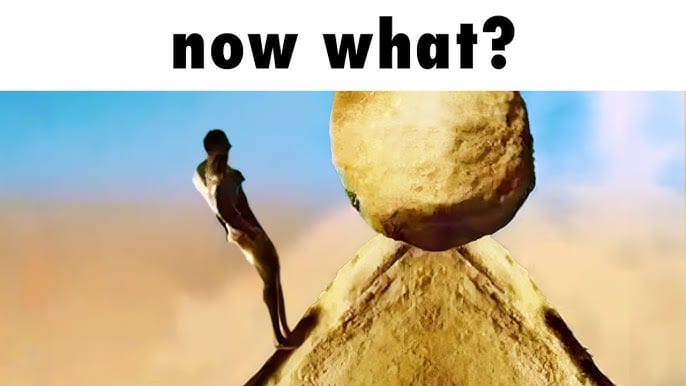
In The Weird and the Eerie, published in 2016, Mark Fisher defines the eerie as a question of agency, the failure of presence when something happens and no one is there to account for it, or the failure of absence when a presence lingers where there should be none. Over the last decade the eerie grew a body online, finding its place in niche online forums. Think about the Backrooms, which began as an anonymous post copied so many times that its authorship got dissolved. Someone on an image board answered a request for 'disquieting images, that just feel off'. They posted a photograph of an empty, yellowing office and a few lines of text. The premise of the post was that if you slipped through reality at the wrong point, you would fall out of the world and into an endless run of vacant rooms, damp carpet underfoot, a single insistent yellow on every surface, the constant maximum hum of fluorescent tubes, and several hundred million square miles of randomly partitioned office space with no exit, and of course, no people in it.
The aesthetic the Backrooms belong to is liminality. The anthropologist Arnold van Gennep used the term a century ago for the disorientation of a threshold, the in-between phase of a ritual when you are no longer what you were and not yet what you will become. Online, it became a visual style: abandoned shopping centers, vintage airport terminals, empty playgrounds at dusk. The property these places share is that all of them are human-made spaces with the humans removed. They are built entirely for people, out of the activity of people, and now strangely vacant of them. The Backrooms is the eerie as an architecture, and the architecture is corporate. It is the office.
Media scholar Shira Chess gives the clearest account of why this particular setting took hold, in what she names the Institutional Gothic. The old Gothic novel kept its dread in crumbling castles and aristocratic bloodlines, with a monstrous lord for an antagonist and the sins of the past pressing on the present. The Institutional Gothic keeps the structure but modernizes it. The looming castle becomes the fluorescent office. The bloodthirsty lord or the monster becomes the faceless corporation.
The reason the dread settles on the office rather than some other room is that the office is being emptied in real life. The decades the Backrooms set in, the 1980s and 1990s, were the height of the cubicle, when reusable office floors looked permanent. Those floors are now half-vacant, and the response of the firms that own them has been to issue return-to-office mandates, ordering people back into the spaces our imagination turns into a horror set. People are being walked, on instruction, back into the liminal architecture, into buildings and with workers the same companies are simultaneously now deciding they no longer need. The physical office and the digital space are filling with the same thing, which is activity with no inhabitants.
Liminality and folklore has stationed a specific figure here; the trickster. The boundary-crosser who deals in disguise and false exchange. Hermes at the crossroads, the goblin at the edge of town, Pan in the dark cave, the thing you meet where the village ends and the forest begins. Jung treated the trickster as an archetype, one of the recurring shapes the collective imagination keeps posted at its borders, because borders are where the rules thin out. In a way, the internet is a threshold that never resolves too. You are always between, always at the edge of town.
There is a running observation, half joke and half real, that these systems are obsessed with goblins and this is a perfect materialization of what we are talking here. Ask a model for a creature with no further instruction and it reaches, obsessively almost, for the goblin. As if the half-formed things from the edge of reality are inhabiting these systems, the tenants of thresholds coming to life through a statistical compression of our collective imagination.
Reading an opaque system
So far you may be wondering how much weirder this piece may get. This is where the occult framing becomes helpful. Nadim Samman, in his book Poetics of Encryption, gives the condition three names: a black box, a black hole and a black site. A black box is a system whose input and output are visible while the process between them stays hidden. A black hole is a region where information and meaning pass beyond recovery. A black site is a physical space that operates outside public visibility. But before we continue, it is worth pausing on the color the three names share. Black is doing the work of opacity, threat, and things that disappear, a habit of language with a long colonial history behind it. The meanings hold, as they are terms used widely, but let's not pass it on unexamined.
Black box
The box is the algorithmic feed, and so is the ranking model behind it. Search engine optimization, posting at particular hours, growth hacking, prompt engineering, the whole vocabulary of feeding the algorithm, are rituals in the exact sense of the word. They are actions performed again and again to influence an opaque higher power whose mechanism the practitioner cannot specify but whose effects they have watched closely enough to imitate. People speak of the algorithm as an agent with preferences and grudges, something that rewards them, punishes them, or finally understands them. The reflex has names in cognitive science, pareidolia and apophenia, the mind's habit of finding faces in clouds and intention in noise. Interfaces court it openly now, with the small sparkle and the wand placed on the button that generates an image, an advertisement placed carefully on the tool itself, trying to convince you that what happens inside is pure magic.
Earlier societies read forests, oceans, and the night sky in the same way, as vast and consequential domains that no individual could fully comprehend, and they generated myths and rituals as a way of coping for that lack of understanding. The occult framing, or digital occultism is an identical behavior pointed at systems and model weights. The myths make an incomprehensible system manageable enough to act in. We conduct rituals because rituals are what remain when the mechanism is sealed.
The tech industry has folklore of its own for the thing it is building, and the folklore is more candid than the marketing efforts. The image that circulates, the meme that depicts AI, is the Shoggoth, a creature out of Lovecraftian lore, drawn as a heaving mass of eyes and mouths with a small smiley mask fixed to the front. The mask is the part you talk to, the friendly assistant with the agreeable name. The mass is everything behind it, the weights, the training data, the processes no one can fully read. It is Samman's black box drawn as a monster, and it is the most honest map anyone in the field has produced of what sits on the far side of the chat window.
Artificial intelligence accelerates entropy, because generative systems produce text and images faster than any process of curation or deletion can keep pace, so the debris is now actively manufactured rather than slowly accumulated. It accelerates the dilution of human presence, because it lowers the cost of automated participation, which is the mechanism Imperva names behind the recent jump in bot traffic.
Black hole
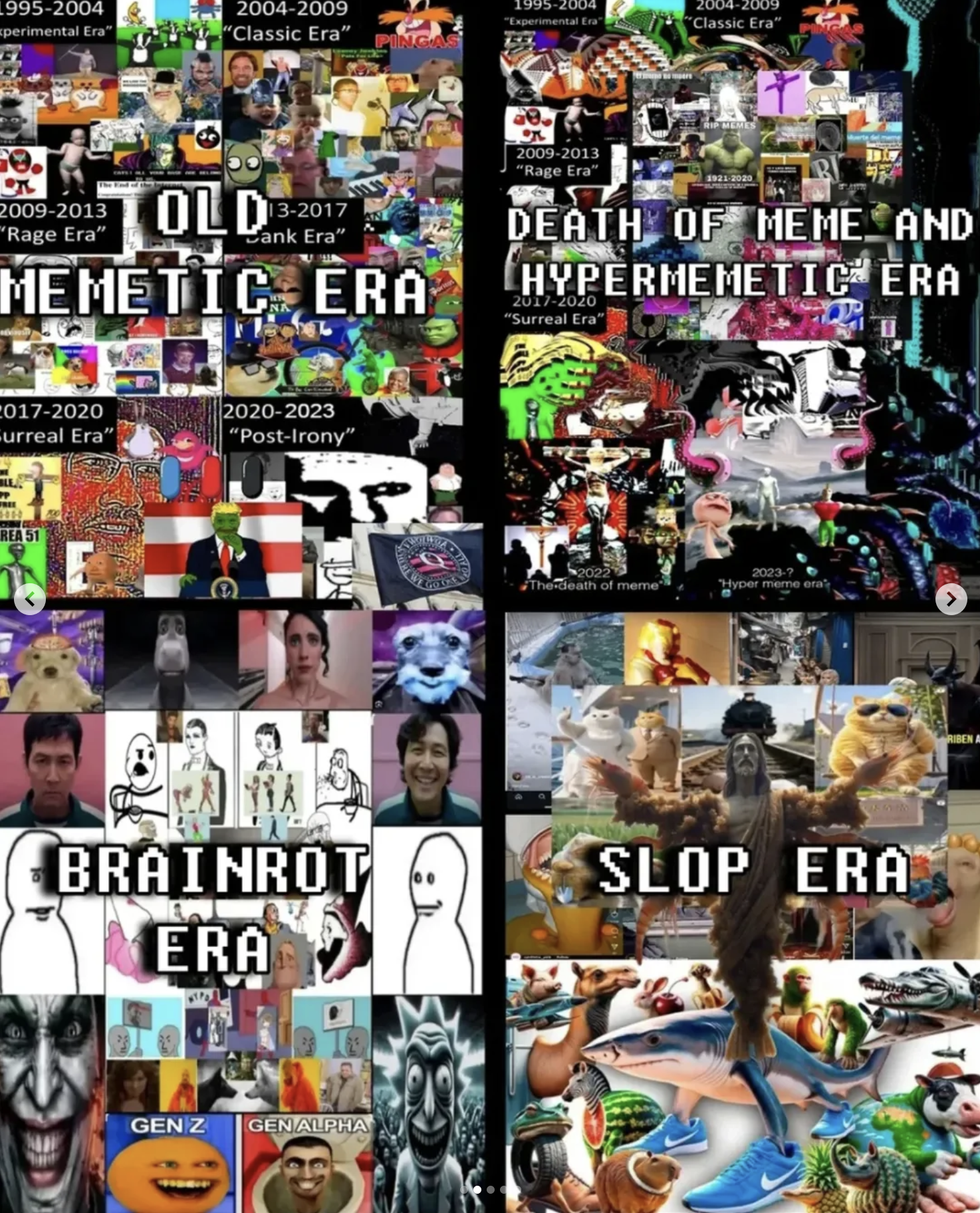
In 2024, Shumailov and colleagues published a paper in Nature on what they call model collapse. When generative models are trained on data produced by earlier models, their performance degrades, and the degradation is irreversible. The tails of the distribution disappear first. The rare, the surprising, and the uncommon go, then diversity falls, and the output converges toward a degenerate center. As synthetic content fills the web that future models will scrape, the training data deteriorates, and the systems increasingly learn from what systems like them have already produced. This is the black hole Samman named. Model collapse builds one, inside the training set, where the rare and the meaningful fall in and do not return. It is the semiophage's signature written into the model itself, the archive that is still there and can no longer be read.
The genuinely new becomes harder to produce, because of all the noise drowning everything we interface with online. The semiophage feeding on machine text trained on machine text, recommended by machines, to an audience that is itself partly machine, sitting on a substrate of decaying human work that the machines are steadily diluting and averaging out. None of this requires a hidden intelligence to be disturbing, it only requires the absence of people and the erasure of the unusual, the novel, and the quirky.
Black site
As the offices empty, the capital that used to build and fill them is being redirected into a different kind of structure, the data center. The five largest hyperscalers spent around 448 billion dollars on capital expenditure in 2025 and have guided toward between 660 and 700 billion for 2026, the large majority of it on AI compute and the buildings to house it, with one analysis projecting 1.15 trillion dollars across 2025 to 2027 and a single announced project, Stargate, carrying a 500 billion dollar ambition on its own.
These are the new institutional buildings. Vast, windowless, climate controlled for machines rather than for people, lit and cooled and humming around the clock, and staffed by almost no one. Eating our resources, competing with us for water and electricity. The office was a human space being emptied of humans. The data center is a space that was never built to hold any human inside it. They are (in Samman's terms) black sites, the physical places that run outside public visibility. Here the secrecy is mundane rather than military, an unmarked building on a ring road with a number where a name should be. This is where the semiophage physically resides. In structures you will never enter, running processes you cannot observe, drawing power on a scale that already rivals small countries.
Memory as praxis
Against the eerie, Fisher positions the weird. The weird is that which does not belong, the intrusion of something genuinely foreign into a setting where it has no place. Where the eerie is presence without presence, the weird is presence that surprises, something arriving from outside the expected order. The weird does not pattern match, so it does not spread, and that is a property the semiophage feeds on. The rare case that is digested first. It is also, for that same reason, the thing most worth protecting, because the weird is the one kind of meaning the machine cannot manufacture, and the part of the internet its logic cannot use. The goal is not to make everything weird again at once, but to keep the weird somewhere the semiophage cannot reach it.
A weirder internet is not nostalgia for the web of the 1990s, because the nostalgia reading gets the politics wrong. The mistake it makes is the one Fisher named capitalist realism, the quiet conviction that the present arrangement is the only one there can ever be. You can hear it whenever people who hate the feed imagine nothing more than a slightly better feed, a tweak to the ranking system, rather than a question about whether ranking should govern anything at all. The semiophage's logic depends on three conditions: scale, measurement, and legibility. Legibility because it is just another word for memetic capture. A space that can be indexed, ranked, and optimized can be fed into the loop. A space that cannot be indexed is, in the strict sense, invisible to the semiophage.
Several existing forms already work this way. Small federated and self-hosted spaces remove legibility, because there is no single ranking system for them to be optimized against. The fediverse, the IndieWeb, personal sites, Neocities, protocols like Gemini, or Atmosphere, none of them resolves to one central authority that can be gamed or fed to an algorithm. Communities small enough that the members recognize one another remove scale, and below a certain size virality is simply not on the menu, so you address people rather than an audience metric. Spaces, where the reward is something other than engagement, remove measurement, because a mailing list or a slow correspondence does not convert your attention into a number the system can grow on.
A shared property of these forms is governance, because they are run by the people who use them, and they are too small or too strange to be worth optimizing. The thing I find genuinely hopeful, is that the safety to explore follows directly from low stakes. When a post cannot go viral, it is finally free to be odd. When a community is not a funnel for someone's growth metrics, it can become a place. The conditions for weirdness and the conditions for psychological safety turn out to be the same, and both are destroyed by scale. You do not get one without the other, and you get neither within the semiophage's reach.
Which returns me to qntm, and to the consolation his book offers. The division (the task-force that fights or tries to capture the antimemes) never wins cleanly. It cannot win against a thing built to be forgotten. What it does instead is it keeps written records it might not be able to read, it repeats the things it must not lose, and it fights the war of memory with the deliberate, unglamorous discipline of refusing to forget. A weirder internet is an act of remembering, on purpose. Building small, illegible, unspreadable places is how you keep the rare and the genuinely new alive against a force built to erase them, and it has to be deliberate, because the default is the smooth average and the empty room.
I do not think the future the early web promised is coming back. But I have started spending more of my time in small places where the network is inhabited by people again, where I can tell that someone is actually there, and where strangeness is permitted because nothing is being optimized. These are the rooms, the inverse of the endless yellow corridors, small enough that they cannot be turned into a set. They are smaller than they were in the past, they are harder to find - on purpose, and what's next now is to build more of them, and to keep them too weird to be found by anything that wants to consume them.
Hope, just like fear, can have hyperstitional effects. In fact, hope increases the capacity to look for an alternative, which in turn increases hope in a virtuous circle.
– Alessandro Sbordoni
Sources
- qntm (Sam Hughes), There Is No Antimemetics Division.
- Guy Debord, The Society of the Spectacle
- Mark Fisher, Capitalist Realism: Is There No Alternative?
- Mark Fisher, Ghosts of My Life
- Mark Fisher, The Weird and the Eerie
- Arnold van Gennep, The Rites of Passage
- Nadim Samman, Poetics of Encryption: Art and the Technocene
- Norbert Wiener, Cybernetics: Or Control and Communication in the Animal and the Machine
- Shira Chess, The Backrooms and the Rise of the Institutional Gothic
- Imperva (Thales), Bad Bot Report
- Ilia Shumailov et al., AI models collapse when trained on recursively generated data
- Data centre capital expenditure
- Sabine Wedege, The Shoggoth in the Chthulucene